Reading the Roots: What Mature Trees on Your Property Are Telling You About Ground Stability
For centuries, farmers, naturalists, and engineers have understood that the natural world communicates in subtle but consistent ways. Trees, in particular, are deeply attuned to the conditions beneath the surface they inhabit. On residential and commercial properties across the United States, mature trees frequently serve as the earliest — and most overlooked — indicators of soil instability and foundation stress.
At Willow Branch Stabilization, our name draws from the very idea that what grows above ground reflects what is happening below it. The willow, famously, seeks water with relentless persistence, its roots tracing moisture through even densely compacted soils. That same principle — that root systems are guided by and responsive to underground conditions — makes mature trees one of the most informative diagnostic tools available to a discerning property owner.
How Root Systems Interact With Soil and Foundations
Tree roots do not simply anchor a tree in place. They are dynamic, pressure-exerting structures that expand, contract, and redirect themselves in response to soil moisture, compaction levels, and available space. In stable, well-drained soil, roots typically spread laterally in a predictable pattern. However, when soil conditions shift — due to drought, poor drainage, clay shrinkage, or erosion — root systems adapt in ways that can directly affect the structural integrity of nearby foundations.
Expansive clay soils, which are prevalent in many regions of the American South, Midwest, and Southwest, are particularly susceptible to volumetric change. During dry periods, clay shrinks significantly, and roots from nearby trees aggressively seek out residual moisture — sometimes following utility lines, drainage channels, or the permeable fill material surrounding a foundation. This root intrusion can displace soil, create voids, and exert lateral pressure on foundation walls and footings.
Conversely, during periods of heavy rainfall, the same clay soils expand, and tree roots can impede proper drainage by blocking subsurface water pathways. The resulting hydrostatic pressure against a foundation is a well-documented contributor to basement wall bowing, slab heave, and perimeter settlement.
Unusual Tree Behavior as a Diagnostic Signal
Many property owners notice changes in their trees without connecting those changes to potential foundation concerns. However, several specific patterns warrant closer attention — and potentially a professional soil or structural assessment.
Sudden or asymmetrical lean. A tree that has stood upright for decades and begins to tilt — particularly toward a structure — may indicate that the soil beneath it is losing cohesion or experiencing differential settlement. Root anchoring depends on consistent soil density, and when that density erodes on one side, the tree responds accordingly.
Stress signs during normal weather. Premature leaf drop, early fall coloration, or wilting during periods of adequate rainfall can signal that a tree's root system is encountering disrupted soil — either overly compacted, flooded, or structurally altered by nearby excavation or settling. These symptoms suggest the tree is struggling to access water and nutrients through a compromised root zone.
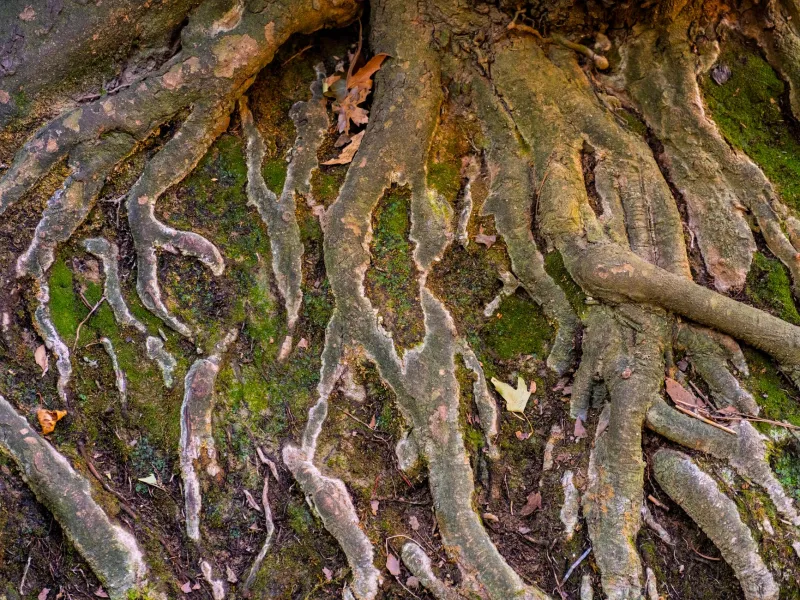
Unusual surface root exposure. When roots begin appearing above grade in areas where they were previously buried, it often indicates that the surrounding soil has been displaced or eroded. This is particularly relevant near driveways, walkways, and the perimeter of building foundations, where soil erosion or compaction can expose root structures that were once well-anchored underground.
Accelerated or directional growth toward structures. A tree that appears to be growing disproportionately toward a building — especially toward basement windows, crawl space vents, or expansion joints — may be following a moisture gradient associated with water intrusion or condensation around the foundation.
The Relationship Between Tree Proximity and Foundation Risk
The general guidance among structural engineers and arborists is that trees should be planted at a distance at least equal to their mature canopy radius from any foundation. However, on established properties — particularly older residential neighborhoods in cities like Atlanta, Dallas, Chicago, and Sacramento — mature trees are frequently situated within ten to fifteen feet of a structure. In these cases, the question is not whether the tree poses a risk in theory, but whether active soil disruption is already occurring.
Species selection matters considerably. Willows, silver maples, American elms, and certain oak varieties are known for particularly aggressive and moisture-seeking root systems. These species, while beautiful and ecologically valuable, require more vigilant monitoring when situated near foundations. Properties with these trees should be considered higher-priority candidates for periodic foundation inspection, especially following prolonged drought or unusually wet seasons.
What a Professional Assessment Looks For
A qualified foundation specialist or geotechnical engineer evaluating a property with mature trees will typically examine several interconnected factors. Soil composition and moisture content near the root zone provide direct evidence of whether expansive soils are actively shrinking or swelling. Ground-penetrating radar or exploratory excavation may be used to identify voids or displaced fill material near footings.
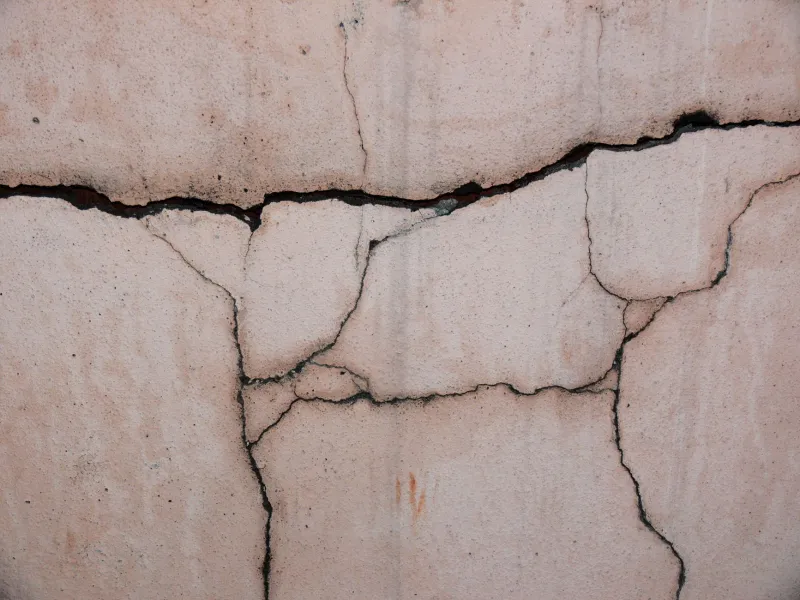
The foundation itself will be examined for signs consistent with root-related stress: differential settlement patterns, horizontal cracking in block or brick walls, and stair-step cracking in mortar joints are all associated with uneven soil movement — the kind that root activity can both cause and accelerate.
In commercial settings, this assessment becomes even more consequential. A stabilization issue that is identified early — perhaps prompted by nothing more than a property manager noticing that a large oak is leaning slightly toward the building — can be addressed at a fraction of the cost of remediation after structural damage has manifested.
Responsible Property Stewardship Begins Below the Surface
There is a tendency among property owners to compartmentalize landscaping decisions from structural ones. Trees are selected for shade, aesthetics, and curb appeal; foundations are inspected only when something goes visibly wrong. But the two domains are inseparable in practice. The soil beneath a property is a unified system, and what affects one element — root expansion, moisture migration, compaction — affects all others.
Responsible stewardship of any property, residential or commercial, means treating the landscape and the structure as parts of the same whole. A mature tree that appears to be thriving may, in fact, be thriving at the expense of the soil stability that your foundation depends upon. Conversely, a tree that is visibly struggling may be doing so because the ground beneath it — and beneath your home — is already in a state of change.
At Willow Branch Stabilization, we encourage property owners to look outward as well as inward when evaluating structural risk. The trees on your property have been observing the ground longer than any instrument has. Learning to read what they are communicating is not a matter of folklore — it is a matter of sound, evidence-based property management.
If you have noticed unusual changes in the trees on your property, or if you have mature specimens growing in close proximity to your foundation, a professional soil and foundation assessment is a prudent and proactive investment. Contact our team to schedule an evaluation and establish a clear picture of what is happening beneath the surface.